


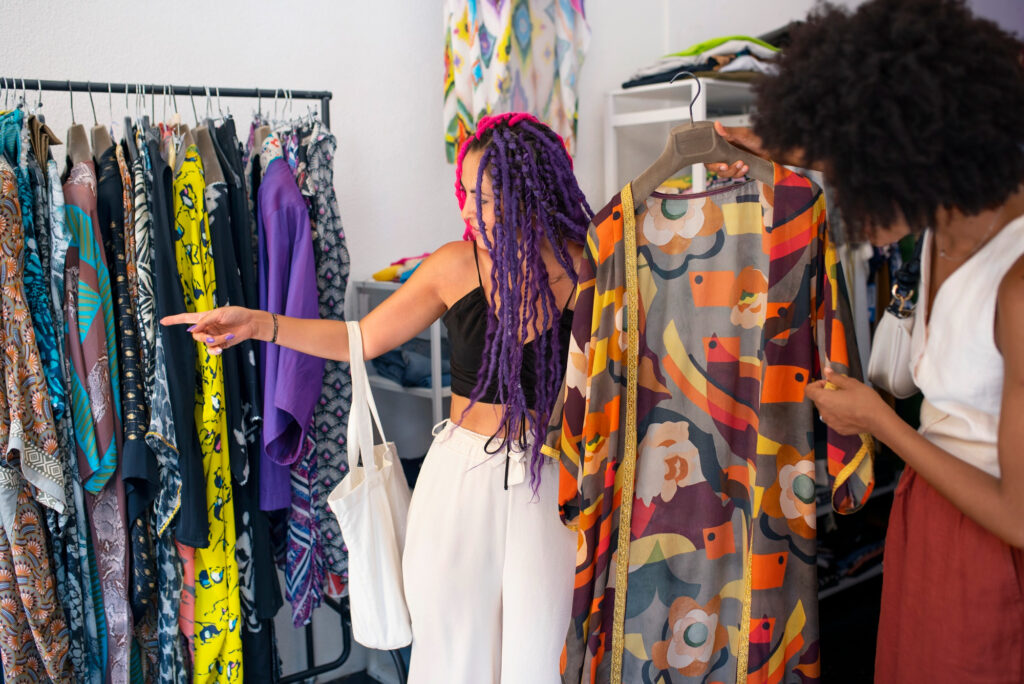

Prints in fashion are often treated as aesthetic choices, but from a psychological and sociocultural perspective, they function as complex visual signals.
Patterns and colours are not neutral design elements, they actively shape perception, influence emotional response, and contribute to how identity is constructed and read in social space.
Prints As Cognitive And Social Signals
In fashion psychology, clothing is understood as a form of “enclothed cognition,” a concept suggesting that what people wear can influence both their psychological state and how others interpret them.
Prints intensify this effect because they carry higher visual complexity than plain garments.
Highly saturated or dense patterns increase cognitive load for the observer. This means they require more attention to process, which naturally makes the wearer more noticeable in social environments.
As a result, printed garments often function as “attention anchors” in crowded visual settings such as urban streets, events, or digital feeds.
This is why prints are frequently associated with extroversion or expressive identity, not necessarily because of personality, but because they increase perceptual visibility and social salience.
Pattern Complexity And Perceived Personality
Research in visual perception and social psychology suggests that pattern type influences inferred personality traits:
- High-density, multi-colour prints are often associated with creativity, spontaneity, and emotional expressiveness.
- Geometric or structured prints tend to signal order, rationality, and control.
- Organic or floral patterns are commonly linked to softness, openness, and approachability.
- Monochrome or low-contrast prints are interpreted as restrained, minimal, or intentional understatement.
Importantly, these associations are not fixed truths about the wearer but learned cultural interpretations shaped by repeated exposure in media, fashion systems, and social norms.
Colour Psychology: Beyond Symbolic Meaning
Colour in fashion is often oversimplified into fixed emotional labels, but contemporary psychology treats colour as context-dependent and culturally mediated.
For example:
- Red does not universally signal passion; in high-frequency urban environments, it functions more as a visibility amplifier and dominance cue due to its wavelength and contrast sensitivity.
- Blue, widely perceived as calming, is also strongly associated with institutional trust (corporate, governmental, digital platforms), which is why it dominates professional and tech branding.
- Yellow, while often linked to optimism, can also increase visual fatigue at high saturation levels, making it more psychologically stimulating than simply “happy.”
- Black, frequently read as sophisticated, also operates as a reduction strategy, minimizing visual noise and shifting focus toward silhouette rather than detail.
When embedded into prints, colour interactions matter more than individual hues. Contrast, saturation balance, and spatial distribution determine emotional impact more than the symbolic meaning of any single colour.
Prints As Identity Construction In Modern Fashion
Fashion identity is not static; it is performed through repeated visual choices.
Now, prints play a particularly strong role in this because they reduce ambiguity. Unlike plain clothing, which can be socially “neutral,” prints force interpretation.
This is why printed fashion is often used strategically in social and digital environments:
- To signal creativity in crowded aesthetic economies like Instagram
- To establish recognisability in personal branding
- To differentiate oneself in urban spaces where similarity is high
- In this sense, prints are not just expressive, they are differentiating tools in identity competition.
Cultural Encoding And Meaning Layering
Prints also carry cultural encoding. In African fashion systems, for instance, patterns are not only visual but symbolic, often referencing heritage, history, and collective identity.
When such prints are recontextualised into streetwear or global fashion, they undergo meaning layering, where cultural significance intersects with contemporary style interpretation.
This creates a dual reading system:
- Internal cultural meaning (heritage, symbolism, tradition)
- External aesthetic reading (trend, style, visual appeal)
- The tension between these layers is part of what makes printed fashion particularly rich as a cultural object.
- Prints in fashion operate at the intersection of psychology, perception, and culture.
They influence attention, shape inferred personality, and function as tools of identity construction in both physical and digital spaces. Colour and pattern are not decorative afterthoughts, they are active components of social communication, deeply embedded in how individuals are seen, interpreted, and remembered.